03 October 2011

Spiritually Minded Cross Messages


Spiritually Minded Cross Messages

"To be carnally minded is death; but to be spiritually minded is life and
peace." Romans 8:6

Fr John Brian uses the timing of Meskel, the Ethiopian festival of the
cross, to talk about the spirituality of the cross.

This sermon uses and refers to scripture readings appointed by the Syrian
Malankara calendar and was give on Sunday, October 02, 2011 by Fr. John
Brian Paprock at Holy Transfiguration Orthodox Mission Chapel, Madison,
Wisconsin.

"We have this treasure in earthen vessels, that the excellency may be of the
power of God and not of us." 2 Corinthians 4:7.

PODCAST OR DOWNLOAD: http://feeds.feedburner.com/frjohnbrian or
http://frjohnbrian.hipcast.com/rss/spiritual_reflections_or_fr_john_brian.xml

Listen on-line here:
http://frjohbrian.blogspot.com/2011/10/spiritually-minded-cross-messages.html

Last week:
Still Following Material Things?
http://frjohbrian.blogspot.com/2011/09/still-following-material-things.html

Previously:
OPF Conference:
Fr. George: The Harvest of Forgiveness
http://frjohbrian.blogspot.com/2011/09/fr-george-harvest-of-forgiveness.html
Fr John-Brian's Opening prayers for the conference:
http://frjohbrian.blogspot.com/2011/09/opening-prayer-forgiveness-finding.html
A Reflection on Forgiveness by Fr John-Brian after the conference:
http://frjohbrian.blogspot.com/2011/09/prose-reflective-prayer-on-forgiveness.html

Bring No More Vain Offerings (Isaiah Chapter 1)
http://frjohbrian.blogspot.com/2011/09/bring-no-more-vain-offerings-isaiah.html

Letting Go - It All Gets Done
http://frjohbrian.blogspot.com/2011/09/letting-go-it-all-gets-done.html

The Devil and the Deep Blue Sea
http://frjohbrian.blogspot.com/2011/08/devil-and-deep-blue-sea.html

Knowing Spiritual Success
http://frjohbrian.blogspot.com/2011/08/knowing-spiritual-success.html

Receive the Crown of Glory (1Peter5)
http://frjohbrian.blogspot.com/2011/08/receive-crown-of-glory-1peter5.html

On the Fruit of Transfiguration
http://frjohbrian.blogspot.com/2011/08/on-fruit-of-transfiguration.html

Recent Writings:
Good Night Hospital (reflection of a night chaplain)
http://frjohbrian.blogspot.com/2011/09/good-night-hospital.html

Opening Prayer - Forgiveness: Finding Wholeness Again
http://frjohbrian.blogspot.com/2011/09/opening-prayer-forgiveness-finding.html

ST. GEORGE : A CHRISTIAN HERO FOR THE MODERN WORLD
http://www.lightoflife.com/LOL_Article_AChristianHeroForTheModernWorld.htm

A Question About Confession
http://frjohbrian.blogspot.com/2010/12/question-about-confession.html

An Assurance of God's Love
http://frjohbrian.blogspot.com/2011/02/assurance-of-gods-love.html

Top FIVE sermons with some Honorable Mentions (November 2005 through May
2009)
http://frjohbrian.blogspot.com/2009/05/top-five-audio-sermons-of-fr-john-brian.html

PODCAST OR DOWNLOAD all sermons: http://feeds.feedburner.com/frjohnbrian or
http://frjohnbrian.hipcast.com/rss/spiritual_reflections_or_fr_john_brian.xml
For more articles and sermons, visit http://www.frjohbrian.blogspot.com/

+*+*+*+*+*+*+*+*+*+*+*+*+*+*+*+*+*+*+*+*+*+
Holy Transfiguration Orthodox Mission Parish
621 N. Sherman Avenue, Suite B3
Madison, Wisconsin - Sundays 9:30am
608.242.4244 ~ transfiguration@usa.com
http://www.maruroopa.blogspot.com/
o HEALING LIFE o DEEPENING FAITH
o ENRICHING PRACTICE o REFRESHING SPIRIT
+*+*+*+*+*+*+*+*+*+*+*+*+*+*+*+*+*+*+*+*+*+
FULLY ALIVE - a Pastoral Book by Fr John Brian, includes transcribed texts
of sermons. Read the introduction and see the table of contents:
http://frjohbrian.blogspot.com/2010/12/fully-alive-introduction.html
Other pastoral books: http://lulu.com/transfiguration

28 September 2011

Ethiopia: Christians Celebrate Discovery of Jesus Crucifix


Ethiopia: Christians Celebrate Discovery of Jesus Crucifix
Luc Van Kemenade
28 September 2011
--------------------------------------------------------------------------------
http://allafrica.com/stories/printable/201109281231.html
--------------------------------------------------------------------------------

Tens of millions of people in Ethiopia celebrated their annual Meskel
eve on Tuesday, an Orthodox Christian festival that landmarks the
discovery of the "true cross" of Jesus Christ by Saint Helena and the
end of the rainy season.
In Addis Ababa the streets are strewn with fresh, yellow-coloured,
daisies, called Meskel flowers in Ethiopia's national language
Amharic, turning the capital city into a colourful bouquet.
On every corner people dressed in white, pile wood, grasses and daisy
flowers into pyramid-like bundles, called demera to make into bonfires
later.
Saint Helena
Ethiopians are honouring Saint Helena's discovery of Jesus' crucifix
in Israel in the fourth century. Helena, who was the first Christian
empress of Rome, is believed to have given the right wing of the cross
as a gift to the Ethiopian Orthodox Church.
The flank is buried near a monastery in Wollo in Ethiopia's northern
highlands, says the church. Ethiopia has a population of over 80
million people, almost half of which are Orthodox Christians.
The heart of the celebration can be found Meskel Square in Addis
Ababa's town centre. Hundreds of thousands of Ethiopians dressed in
elegant robes flock to the slopes of the square to attend a mass led
by the Ethiopian patriarch Abune Pawlos.
Parade
Priests and deacons clap, sing and parade to the sound of large drums.
Crowd members, often held back by policemen, sing, pray and hold up
their eucalyptus candles, turning the stairs into a carpet of light.
In the grand finale of the celebration, the patriarch sets fire to a
giant demera at the centre of the square, symbolising the way Saint
Helena was said to have found the cross that Jesus was crucified on.
According to the legend the smoke from a fire guided her in the right
direction.
Once the fire is lit, there is no way to hold back the frenzied crowd.
People storm into the square to dance around the bonfire and then
reach into the ash to draw small crosses on their foreheads.

23 September 2011

Two ancient churches discovered in Failaka Island of Kuwait

Two ancient churches discovered in Failaka Island of Kuwait

The Department of Antiquities and Museums in the National Council for Culture, Arts and Letters discovered two churches on the island of Failaka reports Al Watan daily. The first consists of three large rooms and three entrances and a tomb of a monk with a cross on it, and the second consists of one room, daily reported.

Al Watan reported, quoting the Director of the department Shihab Abdulhamid Shihab, that a study is being conducted on the churches and other monuments that have been discovered on the island which backdate to the early Islamic era. Additionally, an Islamic village established on the island which includes a mosque, two Mihrab were also found besides and a large Islamic castle called Al-Zour Castle. He pointed out that there are monuments dating back to more than 2200 years BC.

Shihab said that the inhabitants of the Kuwaiti coast before Islam were Christian fishermen, who moved to the islands near Kuwait, including the island of Failaka after the spread of Islam. He added that there are also other ancient civilizations on the island including the Macedonian civilization led by Alexander the Great, who called the Island Icarus.


From: [SOCM-FORUM]

Source: http://indiansinkuwait.com/ShowArticle.aspx?ID=12772&SECTION=0#ixzz1YkBNVemX

__._,_.___

16 September 2011

4th century meditation on the cross

The tree of the cross is for me the tree of eternal salvation. It feeds me
and I feast upon it. With its roots am I rooted and with its branches I
stretch out my arms. It's sap cleanses me and its breeze, like a fragrant
wind, makes me fruitful. Beneath its shadow I have set up my tent and,
escaping the terrible heat, I find there a haven of coolness. It is with its
flowers that I myself blossom and with its fruit that I take my greatest
delight. Yes, those fruits were kept for me from the beginning and I enjoy
them without end... When I tremble before God, this tree gives me shelter;
when I waver, it is my stay. It is the price of my battles and the prize of
my victories; it is my narrow way, steep path, Jacob's ladder where angels
ascend and descend and at whose top the Lord is supported indeed (Mt 7,14;
Gn 28,12).

This tree of heavenly dimensions has been raised up from earth to sky; it is
an immortal plant, set between heaven and earth. Upholding all things,
bearing the universe, support of the inhabited world, it embraces the cosmos
and gathers together the diverse elements of human nature. For itself, it is
assembled of the invisible planks of the Spirit that it may not waver in its
conformity to the divine. Touching the heights of heaven with its top,
grounding the earth with its feet, and encircling with its great arms the
innumerable spaces of the atmosphere, it is wholly in all and around all...

It would have been of no account that the universe was blotted out, melted
with terror before the Passion, if our great Jesus had not infused the
divine Spirit in it when he said: "Father, into your hands I commend my
Spirit" (Lk 23,46)... Everything was shattered, yet when the divine Spirit
rose again the universe was re-animated, brought back to life and recovered
the firmness of its stability. God filled everything, everywhere, and the
crucifixion penetrated all things.

-- A Greek homily of the 4th century
On the holy Paschal mystery, 51, 63 ; PG 59, 743, SC 27 (inspired by a lost
sermon of Hippolytus)

14 July 2011

At the Center of Syriac Christianity is the Cross


In Syriac Christianity, however, the theology of symbols continued [sic] to play a leading role in the Church's life at whose center stands the cross. In the cross all elements of theology are present.  One can justly say that Syriac theology is truly a theology of the cross.

[...]

The cross is also a living reality to be reflected in our daily life. This is possible because we live in a liturgical time which makes the fruits of the cross present here and now. This presence, however, can be felt in two different ways. There is a positive one, through which we benefit from the blessings of the cross, as a protector, a builder of the Church, a teacher, and a sign of peace.  There is also a negative way in which we experience the narrow path which leads us to the cross which causes the fall of its enemies.

It is the eschatological dimension that makes the cross all the more important.  We will fully know and experience the cross in Paradise, where all symbols will find their fulfillment. The cross will open to us the way to the Father by opening the doors of Paradise, and will guard us in our journey towards eternal life. It will lead us to the kingdom of heaven, because it is the sign of that kingdom, and of the King who is going to come for the second time.  Only then, will the cross have fulfilled its mission by bringing us to the fullness of our salvation which we have acheived and lived in our earthly life. The cross thus becomes, as Ephrem says, everything in our life:
 
    The cross is our weapon and will,
     it is our life and light.
     The cross reconciles and renews everybody, 
     it consecrates and sanctifies everyone.
     The cross has become a breakthrough, by which
     the two sides which were angry, are reconciled. 
     (Hymni Dispersi XX,2) 


From:
Symbols of the Cross in the Writings of the Early Syriac Fathers
by Cyril Aphrem Karim (Archbishop of the Diocese of the Eastern United States, Syriac Orthodox Church)
2004, published by Gorgias Press http://www.gorgiaspress.com/

28 May 2011

The Victory of the Cross

The world has value only in so far as through it we see and receive the
revelations and the energies of the person of God who in Himself, in His
essence, cannot be described, but whose energies are already at work in all
creation and will be fully revealed in the transfigured world of the age to
come. Until the last day, God is at work in this world, leading it towards
its
resurrection, above all by means of the cross.

Dumitru Stăniloae
The Victory of the Cross

12 April 2011

Armenian Cross Stones Consecrated - April 2011

On Sunday, April 3, 2011, the Primate presided over the church service at the St. Leon Armenian Cathedral in Burbank. Rev. Fr. Zareh Mansuryan celebrated the Divine Liturgy. Archpriest Fr. Sipan Mekhsian, Cathedral Pastor Rev. Fr. Khajag Shahbazyan and Youth Director Rev. Fr. Avedis Abovian participated in the service.

In his spiritual message, the Primate reflected on the parable of the Unjust Judge and stressed the importance of constant prayer through which we strengthen our relationship with God... 
Following the service, the clergy led the Primate in a procession to the southeast wall of the St. Leon Armenian Cathedral where the Primate, with the participation of the Choir, dedicated and consecrated the crosses carved on the wall. In his message to the faithful, the Primate reflected on the power and the importance of the Holy Cross in the life of an Armenian Christian. He extended his blessings to the donors who were treated to a reception at the Hampar Reception Room. The Primate's signed Certificates of Blessing and Commendation were gifted to the donors during the reception.  

[An "Image Gallery" is at Armenian Western Diocese news web site listed above.]

05 April 2011

Depictions of the Cross before 10th Century


"Christian art seldom shows Christ suffering on the cross before the Tenth Century... A cross without Christ was, however, acceptable..."

Charles Freeman
(from cutline on illustration page of photo of crucifixion detail of 5th Century door of Santa Sabina in Rome)
A New History of Early Christianity
Yale University Press - 2009

27 March 2011

The Sign of the Cross

The Sign of the Cross
Saturday, 26 March 2011 13:40
http://www.holytheotokosgreenville.org/pastoral-notes/36-pastoral-notes/128-
the-sign-of-the-cross

Dear Friends in Christ,

Positions of the Fingers While Making the Sign of the Cross, Licensed from

I'm writing this message the week before the Third Sunday of Lent, when we
commemorate the Holy Cross. The Holy Cross has such an important meaning to
us, that we celebrate it twice a year. Back in September's bulletin, I wrote
about the appearances of the Cross in history. Appearances of the Cross led
to such miracles as the conversion of the Emperor St. Constantine in AD 312.
Since we've so recently covered the appearances of the Cross, I would like
to take this opportunity to speak about a related subject, namely, the Sign
of the Cross.

Humans seem to have a natural desire to identify themselves as part of a
group. One of the ways that members of a group identify themselves to one
another, and cement their ties, is by the use of signs. A well-executed
performance elicits a thumbs-up, the peace sign became a symbol of a
generation opposed to war, and a certain obscene gesture can be used to
insult others. The handshake is used to greet and to seal a deal, and a
salute is used to show obedience to a superior.

Christians from the time of the Apostles have had their own unique sign as
well. This is the Sign of the Cross, which we should make many times a day.
Saint Cyril of Jerusalem (+ AD 386) writes:

Let us then not be ashamed to confess the Crucified. Be the Cross our seal,
made with boldness by our fingers on our brow and in every thing; over the
bread we eat and the cups we drink, in our comings and in goings; before our
sleep, when we lie down and when we awake; when we are traveling, and when
we are at rest.

In other words, making the Sign of the Cross should become second nature to
the Christian, because Christ should be Lord over all aspects of our life.

This Sign should be executed attentively, however; it should not be done out
of habit without reflecting on its action. Each of the many times that we
make the Sign, it should be done deliberately. Let us not fall into the trap
of thinking that by doing something often it will become rote; let us do it
often and with attention! Tertullian (+ AD 220) writes: "We Christians wear
out our foreheads with the Sign of the Cross."

We make the Sign of the Cross properly by taking the thumb, index finger,
and middle finger of our right hand, and joining them together. This
represents the Holy Trinity: Father, Son, and Holy Spirit. We then take the
ring finger and pinky finger of our right hand and close them into the palm
of our hand, representing the two natures of Jesus Christ: divine and human.
With our fingers in this formation, we move our hand to our forehead, to the
solar plexus (navel area), then to our right shoulder, then to our left
shoulder (it should be noted that Roman Catholics make the Sign from the
left to the right, but this is an innovation dating to the 13th century). We
should avoid what some call the "banjo" Sign of the Cross, where the Sign
appears to be more akin to a man strumming an instrument rapidly with no
discernable pattern!

The Sign of the Cross identifies us as Christians, and it wards off the
demons. In fact, in some lives of the saints, we see that when an "angel"
appeared to a monk, he would be naturally cautious and ask the "angel" to
make the Sign of the Cross. At this moment, in many cases, the "angel" would
reveal its true nature, that of a demon, and flee. Demons cannot make the
Sign of the Cross, because of the power of Jesus Christ that the Sign
communicates. In fact, we know that in the last times, some men will take
the Sign of the Beast, or the Devil, instead of the Sign of Christ, upon
themselves: ".that no man might buy or sell, save he that had the mark, or
the name of the beast, or the number of his name" (Revelation 13:17). We
perhaps should not understand this mark to be literal in a physical sense,
but a figurative mark or sign that mimics in opposition the Cross of Christ
that Christians have made since the beginning of the Church. At the same
time, there is a spiritual reality that many of us cannot see because of our
sinfulness, such that the Sign we make with our hand may make a spiritual
impression that is visible to God and the Angels.

As a visible sign to other humans, making the Sign of the Cross marks us as
Christians. It is a mini- "confession of faith." We should never be ashamed
to make the Sign of the Cross in front of other people who are not
Christians (while of course keeping humility in mind). The Sign of the Cross
is seen by the patristic quotes above to be something that dates back to the
beginning of the Church, and should be performed by all Christians. Finally,
in the lives of the Saints, we see the power of the Cross. Many more
examples from the saints' lives could be elicited if there were space in
this column to include them. I encourage you all to do some research on the
topic!

Let us make the Sign of the Cross our own; let it adorn us in everything we
do. May it lead us to greater repentance, and to focus our lives even more
on Our Great God and Saviour Jesus Christ.

In Christ,
Fr. Anastasios

23 March 2011

Inward Sign of the Cross

Throughout its history the sign of the cross has been seen as a mark of Christian identity. From this perspective it is performed so that the sign may be seen by others.  This was the case especially in earlier Christian centuries, as well as during times when Christianity became threatened.

According to the sign's other meaning, which has become more prominent in the last twelve centuries, the gesture of the cross is also a self-blessing, a gesture that imitates and reflects the sacramental blessing of the priest.

As both interpretations suggest, it is not directed towards God - unlike the gesture of the outstretched arms. In the first case, as the mark of Christian identity, it is directed at someone else.  And in the second case, as a gesture of blessing, the sign is turned toward the self. In both cases, since it is traced over the body, its conceptual start is the most graspable sense of the self, which is the body. Where the gesture of the outstretched arms formed an invocation, the inward direction of the sign of the cross creates a gesture of profession of and acceptance of the faith.  Both the sign of the cross and the gesture of the outstretched arms signify prayer, but the direction, and therefore the meaning of the prayer formed by the gesture, is different in each case.

Lifting the hands is something we do when we address God in heaven. This form of address works similarly to the way we communicate among oursleves.  We speak, and our words are sent, offered toward and heard by the other person.  Tracing the sign of the cross over one's body is different.  We gesture the sign of the cross when we invite God to talk to us, to accept and clean our body and our entire being, so that our body becomes a temple for God to dwell in.  This kind of prayer is more contemplative in nature.  It starts with the self and is directed to God in heaven through an inward journey.


Andreas Andreopoulos
The Sign of the Cross: The Gesture, The Mystery, The History
Paraclete Press, 2006
pp 72-73

12 January 2011

Orthodox Church Celebrates 358th Anniversary of Bent Cross Oath

Orthodox Church Celebrates 358th Anniversary of Bent Cross Oath

Written By: on Jan 11th, 2011

 
MATTANCHERY: Orthodox Church celebrated the 358th anniversary of historical Bent Cross (Coonan Cross) Oath on Monday January 3, 2010 at the Mattanchery Church.

Metropolitan of Kochi Diocese Dr. Yakob Mar Irenaeus inaugurated the meeting. Fr. Geevarghese Kochuparambil Ramban delivered the keynote address. Fr. P.I. Varghese, Fr. Sunil Jacob, and Fr. Simon Joseph spoke on the occasion.

Special Holy Qurbana and prayers were conducted earlier to mark the remembrance of those fathers, who pledged 358 years back holding on to the rope tied upon the stone cross as a symbol of their renunciation of foreign dominance in faith.

The procession with 358 lighted candles donned a new experience of history to the faithful.

Fr. Geevarghese Thomas Panickasseril welcomed the gathering. Number of faithful from all neighboring parishes participated in the event.

http://www.orthodoxherald.com/2011/01/11/orthodox-church-celebrates-358th-anniversary-of-bent-cross-oath/?utm_source=feedburner&utm_medium=email&utm_campaign=Feed%3A+orthodoxherald+%28Indian+Orthodox+Herald+-+Breaking+Church+News+And+Doctrinal+Information%29

03 January 2011

The Finding of the True Cross

+ The Finding of the True Cross +

According to Ethiopian Orthodoxy, after the ascension of Jesus, the
cross on which he was crucified began performing extraordinary
miracles. This raised the ire of the people who crucified Jesus, who
then ordered the cross to be removed and buried in the outskirts of
town. Residents living in the surrounding areas were commanded to dump
their garbage on the site, and for the next three centuries the area
turned into wasteland.

Three hundred years later, in the early fourth century, the Roman
Empire was being ruled by Constantine the Great. His mother, St.
Elleni (Helena), concerned about the plight of Christians, beseeched
her son to allow the free practice of Christendom in her son's empire.

The Emperor consented, and St. Elleni traveled from Constantinople to
Jerusalem to look for the buried Cross. Once in Jerusalem, however, no
one could tell her the exact spot where it lay. It is said that she
went into seclusion and prayed for God's guidance.

As a result of her prayer, St. Michael the Archangel appeared unto her
and gave her certain instructions. She ordered her soldiers and the
local residents to gather a pile of firewood. After a prayer, a fire
was set ablaze the wood. Clergymen doused incense on the flame and the
smoke of the incense rose up towards the sky then arched down to the
earth, pointing out the exact spot where the Holy Cross was buried.

Following this miraculous sign, digging began and commenced for six
months until the True Cross was discovered.

This has been the premise of the celebration of "Mesqel" in the
Ethiopian Orthodox Church. Since then, clergy and parishioners have
dressed in traditional, colorful clothing to sing ancient hymnals
dating back to the sixth century. A bonfire is lit up to memorialize
the finding of the True Cross.

http://www.ethiopianorthodoxchurch.info/CalanderFastsFeastsDays.html

14 December 2010

pectoral cross

Eastern Orthodox practice
Russian Orthodox Archimandrite Palladius, wearing gold pectoral cross with jewells (1888).
Russian Orthodox Palladius, wearing gold pectoral cross with jewels (1888).

In Eastern Orthodox practice, the pectoral cross is worn by all bishops but not necessarily by all priests. In the Greek tradition, the pectoral cross is only given to specific priests for faithful service; in the Russian tradition, the silver cross is worn by all priests. Whenever the cross is put on, the wearer first uses it to made the Sign of the Cross on himself and then kisses it and puts it on.

The priest's cross depicts the crucified Christ, whether in painted form as an icon, or in relief. However, the Orthodox crucifix differs from the Western type by the fact that the soma (body of Christ) is not in full three-dimensional form, but in no more than three-quarter relief. It also bears the inscription INBI (the titulus that Pontius Pilate placed above the head of Jesus at the crucifixion) and the letters IC XC NIKA around the four arms of the cross. Orthodox pectoral crosses are almost always on chains of either silver or gold, sometimes with intricately worked links. Priest's crosses will often have an icon of Christ "Made Without Has" at the top. This is the icon before which Orthodox Christians usually confess their sins. In Russian practice, the back of a priest's cross is usually inscribed with St. Paul's words to St. Timothy: "Be an example to the believers in speech and conduct, in love, in faith, in purity" (1 Tim. 4:12).

Orthodox pectoral crosses are awarded in several degrees (particularly in the Russian tradition):

  • The Silver Cross is awarded to all priests by their bishop on the day of their ordination. This tradition began with the last Tsar, Nicholas II, who awarded a silver cross to every priest in the Russian Empire. Even after the fall of the Romanov Dynasty, the practice of awarding the Silver Cross to Russian priests at their ordination has continued to this day. This practice helps to distinguish priests from deacons or monks, all of whom wear the same type of riassa(cassock), and are otherwise indistinguishable when not vested. The Silver Cross is not enameled or decorated in any manner except for engraving or relief. Russian Orthodox priests do not wear the cross by right of their priesthood, but only by permission of their bishop. One way a bishop may punish one of his priests is to forbid him to wear the priest's cross.
  • The next-ranking award is the Gold Cross. This is a simple gold cross, similar to the Silver Cross, and similarly without enameling or other decoration. The Gold Cross is worn by archpriests, abbots and abbesses as a mark of their office, and may be awarded by the bishop to other priests, both married and monastic, for distinguished service to the church.
  • The highest pectoral cross, is With Decorations?that is, jeweled, and sometimes enameled?and normally has a depiction of an Eastern-style miter at the top. This type of pectoral is also referred to as a "Jeweled Cross". This type of cross is worn by bishops, archimandrites and protopresbyters as a sign of their office, and may be awarded to other priests as well. All bishops are entitled to wear the pectoral cross with decorations, although most simply wear a Panama when not vested for services.

When vesting before celebrating the Divine Liturgy, the pectoral cross is presented to the bishop who will bless the pectoral, cross himself with it, kiss the cross and put it on. Meanwhile the Protodeacon, swinging the censer says the following prayer:

He who would be my disciple, let him deny himself, take up his cross and follow me (Matthew 16:24, etc.); always, now and ever, and unto the ages of ages. Amen.

A priest may be granted the right to wear a second pectoral cross.

A priest who has been given the pectoral cross will typically wear it at all times, whether vested or not.

In Russian practice, a nun who is not an abbess may also be granted the privilege of wearing a pectoral cross, as an honorary award (however, this award is not granted to monks who are not priests).

04 December 2010

St. Gregory of Nareg's Vision of the Cross

Only in Armenian: Roberta Ervine on Gregory of Nareg

By David Luhrssen

(Milwaukee, Wis.) The cross is the universal symbol of Christianity, but as Roberta Ervine pointed out in her talk at St. John the Baptist Armenian Church of Milwaukee, the word has a particular richness in Armenian. In her March 14, 2010, presentation, “Only in Armenian: St. Gregory of Nareg’s Vision of the Cross,” the Armenian studies professor at St. Nersess Seminary began by contrasting the often negative associations of the English word cross with the richer meanings of the Armenian khach and its synonyms. In English, cross is a torture device, a cross to bear, especially if one is at cross-purposes. In Armenian, the word takes on associations with living and positive things such as Khachen Genarar (Life giving Cross) Pergoutyan Khach (Saving Cross), with trees and with staffs to support our burden.

Ervine focused on the 11th century mystic whose prayers and poems offer a vivid spiritual vision. St. Gregory of Nareg was in ill health and had reason to be resentful over the poor treatment of his father, a bishop driven into exile. And yet, as Ervine stressed, Gregory was able to love a church that was sometimes led by hateful men.


In St. Gregory’s writings, the cross took on many positive connotations. He visualized it as a knife’s edge freeing us from the bonds of oppression. He noticed that the unique configuration of the Armenian cross radiated like the rays of the sun to light our consciousness. The cross represented sacrifice in the form taken by altars in Armenian churches, where a horizontal plane meets a vertical support. For St. Gregory the cross was also like a wine press, transmuting grapes under steady pressure into wine. The wild horses that roamed near his monastery on the shore of Lake Van reminded him that their wildness could be tamed by a bridal, much as the cross can train human nature if Christ holds the reins to guide us. The cross symbolizes the key to our inner nature and the kingdom of heaven.

Illustrating her talk with visuals of Armenian religious art, Ervine summarized St. Gregory of Nareg’s views by saying that the cross for him was not an instrument of death, holding the dead body of the Son of God, but the Tree of Life, and is often represented in Armenian iconography as a living thing bearing branches and grape vines. The writings of St. Gregory, she concluded, are an invitation to see the deeper meaning of the cross in our world.

15 September 2010

The Miraculous Power of the Cross and Prayer - A Scientific Study

The Miraculous Power of the Cross and Prayer - A Scientific Study

Moscow, March 17, 2006 - Interfax - Scientists have proved experimentally
the miracle-working properties of the sign of the cross and prayer.

'We have ascertained that the old custom to make a sign of the cross over
food and drink before a meal has a profound mystical meaning. Standing
behind it is the practical use: the food is purified literally in an
instant. This is a great miracle, which happens literally every day,'
physicist Angelina Malakhovskaya said as cited by the Zhizn newspaper on
Friday.

Malakhovskaya have studied that power of the sign of the cross with the
blessing of the Church for nearly ten years now. She has carried out a great
number of experiments, which have been repeatedly verified before their
results were made public.

She has discovered in particular the unique bactericidal properties of water
after being blessed by an Orthodox prayer and a sign of the cross. The study
also revealed a new, earlier unknown property of the word of God to
transform the structure of water, increasing considerably its optical
density in the short ultra-violet spectral region, the newspaper writes.

The scientists have verified the impact the Lord's Prayer and the Orthodox
sign of the cross make on pathogenic bacteria. Water samples from various
reservoirs - wells, rivers, lakes - were taken for the research. All the
samples had goldish taphylococcus, a colon bacillus. It turned out however,
that if the Lord's Prayer is said and a sign of the cross is made over them,
the number of harmful bacteria will decrease seven, ten, hundred and even
over thousand times.

The experiments were made in such a way as to exclude a possible impact of
mental suggestion. The prayer was said by both believer and non-believers,
but the number of pathogenic bacteria in various environments with different
sets of bacteria still decreased as compared to the reference templates.

The scientists have also proved the beneficial impact that the prayer and
the sign of the cross have on people. All the participants in the tests had
their blood pressure stabilized and blood indexes improved. Strikingly, the
indexes changed towards the healing needed: hypotensive people had their
blood pressure raised, while hypertensive people had it reduced.

It was also observed that if the sign of the cross is made off handedly,
with the three fingers put together unscrupulously or placed outside the
necessary points - the middle of the forehead, the center of the solar
plexus and the recesses in the right and left shoulders - the positive
result was much weaker or absent altogether.

http://www.johnsanidopoulos.com/2009/05/miraculous-power-of-cross-and-prayer
.html

06 September 2010

Siberian Orthodox Cross

Courtesy of  Gary Ivan Cabral Flores

26 June 2010

Archaeologists find oldest Orthodox Christian church

From: OrthodoxNews@yahoogroups.com

http://www.directionstoorthodoxy.org/n/archaeologists_find_oldest_orthodox_c
hristian_church.html

Archaeologists find oldest Orthodox Christian church

Posted on Tue Jun 10 2008

The Jordan Times reports that a group of archaeologists have unearthed the
world's oldest Orthodox Christian church in Rihab, Jordan. Rihab is in
Northern Jordan. Rihab is home to a total of 30 churches and Jesus and the
Virgin Mary are believed to have passed through the area.

The church, which was built underground, dates to somewhere between 33 and
70 AD. Rihab is located about 30 miles east of the Jordan River and a
roughly equal distance north of the Jordanian capital, Amman. The region is
home to 30 other ancient churches.

"We have uncovered what we believe to be the first church in the world,
dating from 33 AD to 70 AD,"
Abdul Qader al-Husan, the head of Jordain's Center for Archaeological
Studies said.

He said it was uncovered under Saint Georgeous Church, which itself dates
back to 230 AD, in Rihab in northern Jordan near the Syrian border.

"We have evidence to believe this church sheltered early Christians -- the
70 disciples of Jesus Christ," Husan said.

These Christians, who are described in a mosaic as "the 70 beloved by God
and Divine," are said to have fled persecution in Jerusalem and founded
churches in northern Jordan, Husan added.

He cited historical sources which suggest they both lived and practiced
Christian rituals in the underground church and only left it after
Christianity was embraced by the Roman Empire.

Archimandrite Nektarious, a representative of the Greek Orthodox Church,
described the discovery as an "important milestone for Christians all around
the world."

Researchers recovered pottery dating back to between the 3rd and 7th
centuries, which they say suggests these first Christians and their
followers lived in the area until late Roman rule.

Inside the cave a circular area of worship with stone seats separated from
living quarters were found. This circular element, called an apse, is
important says Dr Al-Hassan because there is only one other example of a
cave with a similar feature, which was also used for Christian worship. The
stone seats are believed to have been for the use of clergy.

Al-Hassan said: "We found beautiful things. I found the cemetery of this
church; we found pottery shards and lamps with the inscription 'Georgeous'".
There is also a tunnel that leads to a cistern which supplied water to the
dwellers. The excavation of the tunnel and the cistern may yield yet more
evidence about the lives of these early Christians.

"From the tunnel to the cistern is very important. We want to clean it and
make an excavation inside it. We found a very old inscription beside it and
coins also, and crosses made from iron."

Other experts say they are cautious about the claim. They want to examine
the artifacts and obtain solid dating evidence. The earliest confirmed
examples of churches date from the third century.

14 June 2010

Bikers in Belarus Process with Cross

June 2. (Wednesday). 15:39:59
In Bobruisk, before the gathering of bikers, a religious procession on
motorcycles was held

Last night Bobruisk hosted the national gathering of bikers "Motofest 2010",
organized by the local club "Night Wolves". As the site of the Diocese of
Bobruisk mentions, the program activities included motorcycle and show
rides, demonstrations of the Cossack the art of riding, concerts and
socializing by motorsports enthusiasts in the open air 2 km from the new
bridge across the Berezina River.

The event began with Procession of the Cross on motorcycles over the
distance of 27 kilometers on the ring road around Bobruisk. In the event's
organization, in addition to fans of two-wheeled vehicles, also took part
local Cossacks and representatives of youth and information departments of
the Bobruisk diocese.

It should be noted that the Moto-Procession of the Cross was organized in
accordance with ancient canons: first came the lantern, then processional
crosses and banners. Priest Dmitry Pervyj, who participated in procession,
sprinkled holy water on path and accident-prone crossroads of the city ring
road on the Berezina.

Upon completion of the Procession of the Cross motorcycle equipment and
venues were blessed. Bikers are lovers and fans of motorcycles. Unlike
conventional motorcyclists, for bikers motorcycles are part of their
lifestyle. Characteristic is also the association with like-minded people on
the basis of this way of life.

The biker movement was born in 1950 in the U.S., and penetrated into Europe
(in the USSR in the 1980's they were called "rockers"). Until recently, the
term "biker" applied exclusively to the owners of choppers and always was
associated with a remotely extended front wheel, plenty of chrome, leather,
long hair and bearded motorcyclists. However, since the late 90-ies on the
road one began to see motorcycles with high-performance engines covered in
plastic fairings - sportbikes.

The stereotypical look of a biker: bandana (headscarf) in dark colors, tied
at the back of the head pirate style) or black knit cap, black leather
jackets (leather jacket with a closure off-center) or leather motojacket
(often worn denim or leather vests with no sleeves are worn over the
motojacket) with colors (symbols) of the motorcycle club), leather pants.
Bikers often let their hair grow long, and have a mustache and beard. To
protect their eyes from the wind they wear goggles, while helmets are often
ignored.

/ sobor.by/ Viktor Melnichenko / photo from the website: bobruisk.hram.by

==============================================================

http://sobor.by/idnews.php?id=2010-Jun-2-15:39:59

Note the photo: the altar servers on the backs of the bikes (holding the
lantern and processional crosses) are wearing their stikharions (but no
helmets).
With love in Christ,
Prot. Alexander Lebedeff

13 May 2010

The Cross is an Ascension Symbol

Happy Ascension! This a sermon given a few years ago that delves into the importance of the Ascension and the Cross in the East:

http://maruroopa.blogspot.com/2007/05/cross-is-ascension-symbol-festal-sermon.html

your servant,

Fr John Brian

http://frjohbrian.blogspot.com


10 June 2009

The Stone crosses of Kerala

The Stone crosses of Kerala

 Written by NSC- Admin on Tuesday, January 16, 2007 3:15 - 20 Comments

Kerala has many churches of antiquity. It is recorded that before the arrival of Portuguese there were more than 150 ancient churches in Kerala. 

The Synod of Diamper conducted in 1599 had a representation of more than hundred churches of the St. Thomas Christians. Though not all of these churches are preserved, many of them gave indication to the importance stone crosses had in early Kerala Christian life.  

Christian art and architecture in Kerala in the pre-European periods are developed by nourishment from two sources. From the countries in the near-east including Greece, Rome, Egypt and other Middle East countries from which ideas and practices were imported by missionaries and traders, and secondly from the indigenous forms and techniques of art and architecture that existed in the land. The nourishment of these two sources can be seen in the Stone crosses of Kerala. 

There are two types of rock crosses in Kerala Churches broadly classified as St. Thomas cross and Nazraney sthambams. 

1. St. Thomas Cross  

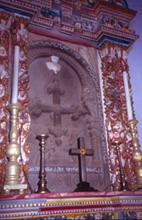
The small interior type rock cross is called St Thomas cross or Nasrani Menorah or Syrian Cross. This crosses are found at St. Thomas Mount, Kottayam [ 2 nos ], Kadamattam, Muttuchira, and Alangad. This has been venerated by all St Thomas Christians from ancient times. They have inscriptions in Pahlavi (Middle Persian) and Syriac which indicate that they date to before the eight century.  http://nasrani.net/wp-content/uploads/2008/09/stonecrosses.jpg

These older carved crosses are located inside the churches and are considered particularly sacred and worthy of veneration by the St Thomas Christians. These crosses are very decorative and are not typical crucifix.  These are plain crosses which doesnot show Christ on the cross. In Eastern Christianity and Syrian Christianity, the plain cross is the symbol of the triumph of Christ’s life over death. It is of  symbolism in Eastern Christianity.

These crosses are also sometimes called Leaved Crosses or Persian crosses as they symbolise at the bottom a set of leaves. The leaves usually flow upwards either side of the base of the cross symbolizing the cross as the tree of life.  But some of these crosses from Kerala the leaves are downward pointing. This is indigenous and this symbolism and tradition is not find in Persian or Middle East or even in Byzantine art.    

2. Nazraney Sthambams 

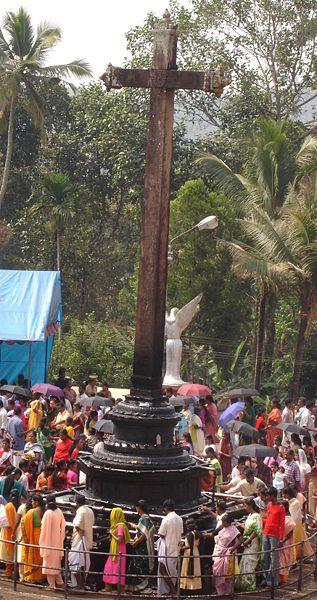
The giant open air rock cross are called Nazraney Sthambams.  The plinth of these crosses represents lotus petals and lotus flowers and has a square base. It also has a variety of iconographic motifs, including elephants, peacocks and various other animals, depictions of the Holy Family and of the Crucifixion, to name a few.  http://nasrani.net/wp-content/uploads/2008/09/nazraney_sthambams_nsc.jpg

These crosses are found in Kottekkad, Enammavu Mapranam, Puthenchira, Parappukkara, Veliyanad, Kalpparambu, Angamaly, Kanjoor, Malayattoor, Udayanperur, Kuravilangad, Uzhavoor, Chungam, Kaduthuruthy [2 Nos.], Muttuchira, Kudamaloor, Niranam, Kothamangalam, Chengannur, Thumpamon, Chathannur and many other places. 

These crosses are very large, freestanding crosses found outside the churches. They are usually aligned  to the west end of the church. On festival days and during processional days when people process around these crosses. People also burn coconut oil as an act of offering and reverence at the base of these large crosses on their pedestals.  

The plinths represent lotus petals and lotus flowers as the cross is sitting on top of a lotus flower. There is a square base, it’s a circle on a square with a cross on top. The circle as the lotus flower represents the divine, heavenly aspect, on the square which represents the earth.  

There are depictions of the holy family. There are imags of Mary and the Christ Child, also of the Crucifixion in these crosses. There is a variety of iconographic motifs including fish, various animals, elephants. The elephants are very much part of an Indian context.

There are even archway’s in older churches which shows two elephants either side of the cross on a plinth.  The elephants are coming to venerate the cross. And on the other side of the archway, there are peacocks sitting either side of the cross. This represents the  indigenisation of stone crosses and Christian symbols in India.   

There are depictions of the holy family, images of Mary and the Christ Child and also of the Crucifixion.    

Reference 

Ancient Kerala Christian Art- Prof. George Menachery 

Stone crosses of Kerala- Dr Ken Parry, Department of Ancient History at Macquarie University, Sydney

Rock Crosses of Kerala- Prof. George Menachery 

26 March 2009

Meaning of the Mid-Lent Cross

Meaning of the Mid-Lent Cross
(special sermon)

There are four powerful prayers in each of the four directions with the Mid-Lent Cross. This sermon is on the meaning of the Mid-Lent Cross, the golgatha, King Abgar and the healing power of the prayer for this auspicious time.

This sermon was given for Mid-Lent, March 18, 2009 by Fr John Brian Paprock at Holy Transfiguration Orthodox Mission Chapel, Madison, Wisconsin.

PODCAST OR DOWNLOAD: http://feeds.feedburner.com/frjohnbrian or http://frjohnbrian.hipcast.com/rss/spiritual_reflections_or_fr_john_brian.xml
LISTEN ONLINE HERE:

The Blessing Cross

Dear Father John,

I want to express my thanks for the beautiful article you wrote on the
glorious Cross. I have emailed it to many people, because I think it truly
captures the significance of our blessed symbol of redemption and salvation.

In the Ethiopia Orthodox Church we pray the Prayer of the Cross every day:
The Cross is our power.
The Cross is our strength.
The Cross is our redemption.
And the Cross is the salvation of our souls. Amen

May Our Lord and Our Lady bless you as you continue to use your gift of
writing to proclaim the glorious truths of the Orthodox Faith.

Selam,

Gebre Menfes Kidus

The article "The Blessing Cross" by Fr John Brian was recently published on
the ICON website:
http://www.icon.org.in/jsp/icon/resources/BlessingCross.pdf

27 January 2009

Saint Nino's Cross - The Grapevine Cross

On January 26, Saint Nino's Cross was brought to the Dusk Prayer and put down at the center of the temple. This is the very cross with which the saint baptized the whole Georgia. The believers will have a chance to visit the cathedral in the evening of January 27 and worship the miraculous cross.


...


The Grapevine Cross ("Jvari Vazisa" or ჯვარი ვაზისა in Georgian), also known as Saint Nino's cross, is a major symbol of the Georgian Orthodox Church, and dates back to the 4th century AD, when Christianity became the official religion of the ancient Georgian kingdom of Iberia, thanks to the missionary work of St. Nino.

Legend has it that Nino received the Grapevine Cross from the Virgin Mary and bound it together with her own hair. This was the cross Nino brought with her when she came to evangelize the Georgians. The Grapevine Cross is recognizable by its slightly drooping horizontal arms.


...

...in the night the Holy Mother of God appeared to Nino in a vision and said to her, "Depart into the land of the north and preach the gospel of my Son, and I will guide and protect you." But she answered in alarm, "Queen, how may I accomplish this ? For I am a worthless and ignorant woman." Then the Holy Queen stretched out her hand upon a vinebranch which grew close to Nino's bed and cut it off and fashioned it into a cross and gave it to Nino, saying, "Let this be your protection. By it, you may overcome all your foes and preach your message. I will be with you and not abandon you."

After this vision, Nino awoke and found the cross in her hands. When morning came, she went out and told all this to the Patriarch and showed him the cross, and the Patriarch gave thanks to God. Then Nino begged the Patriarch to send her with the noble lady who was leaving for Ephesus. So she received the Patriarch's blessing, and set off in company with the noble lady.....

When the blessed Nino saw this, she began to sigh towards God and shed tears because of the errors of this northern land, for the light was hidden from its people and the reign of darkness enclosed them. she lifted up her eyes to heaven and said, "O God, by Thy great might throw down these enemies of Thine, and make this people wise by Thy great mercy, so that the whole nation may worship the only God through the power of Jesus Christ Thy Son, to whom belong praise and thanks for evermore."

After St. Nino had uttered this prayer, God immediately sent winds and hurricanes out of the west, with clouds sinister and grim in appearance. The noisy roar of thunder was heard, and at sunset a wind blew with a fetid and unpleasant smell. When the crowd saw this, they ran away as fast as they could towards their homes in the city. God granted them but little time, and when they were all safely home, His anger burst fiercely out from the sinister cloud. Hail fell in lumps as big as two fists on to the abode of the idols, and smashed them into little pieces. The walls were destroyed by the terrible gale, and thrown down among the rocks. But Nino remained unharmed, watching from the same spot where she had stood at the beginning.

Three days later she got up, crossed the River Kura, and found outside the walls of the city a bramble bush growing in the shape of a small tent. she made a cross of vine-shoots and stayed there to pray.....

Now when the king and queen severe baptized with their Children and all the people, there stood on the crest of a remote crag a tree of wondrous beauty and sweet scent. It was a miracle-working tree, for wild animals wounded by arrows used to come to it and eat its leaves or its seeds which had fallen to the ground, after which they acre healed, even if they had suffered fatal wounds. The common folk, who had previously been pagan, considered this a great marvel, so they told Bishop John about the tree. Anal the bishop said, "Behold, this tree has been planted by God specially for this occasion. Now that the grace of God has shone forth upon Georgia, from this tree shall be carved the holy cross which all the multitudes of Georgia shall adore." Then Rev, the king's son, went with the bishop and many of the people and cut down the tree, and a hundred men carried it to the city with all its branches and leaves. The people collected to see it, because of the fresh green leaves which it had at a time when all other trees were bare. Its foliage had not fallen and it was sweet-smelling and beautiful to look at. They stood the tree up on its base at the southern door of the church, where the breezes wafted its fragrant scent about and unfolded its leaves. There the tree stood for thirty-seven days, and its leaves did not change colour. It looked as if it was standing immersed front root to topmost twig in a stream, and remained thus until all the tress of the forest were clothed in verdure, and the fruit trees were in blossom. Then on the first of May they fashioned three Crosses from it, and on the seventh thus raised them up in the king's presence amid popular rejoicing on the part of the crowds gathered in the church. Soon afterwards, the people of the city saw a fiery Cross Come down from heaven. Round about it was what appeared like a crown of stars. The cross of fire rested on the church until claws. When daylight came, two of the stars separated from the others—one going eastwards and the other towards the west. The brighter of the two went gently towards a spot near a stream on the far side of the river Aragvi, and Stood over the rocky hill out of Which a rivulet had sprung from the tears of Nino. From there the star rose up to heaven. They asked the blessed Nino, "What is the meaning of these bright stars, one of which as gone eastwards towards the mountains of Kakheti, and the other to the western outskirts of this city?" St. Nino answered, "When you have found where the stars are Shining over those hills, there let two crosses be raised to Christ." The king acted accordingly, and melt went to inspect the highest mountains, one after another. Some went to the West, where they climbed the hill called Cavern's Head. These men reported to the king that one star had parted company from the others to take up a position over Mount Tkhoti by the pass of Caspi, after which it was lost to their sight. Similarly, those who had been sent to the hills of Kakheti returned to tell hoes they had seen a star move in that direction and stand over the village of Bodbe in the district of Kakheti.

Then St. Nino said to them, "Take two of these crosses, and raise one in Tkhoti where God revealed His power. Give one to Christ's handmaiden Salome to be erected in the town of Ujarma. The village of Bodbe in Kakheti should not be given preference over the royal city of Ujarma, where there arc great numbers of people, but Bodbe also shall later witness God's grace." So they did as Nino directed.

In Mtskheta also they raised the wonder-working holy cross, and they went dozen to the stream which flows past the mound, and there they passed the night praying to God. Next day, the countless multitude knelt and worshipped the cross, and confessed the Crucified to be the True Son of the Living God, and they believed in God Almighty, Three in One. And on Easter Sunday, King Mirian and all Mtskheta offered up prayers and thanksgiving. On that day they instituted the service of the Cross at Easter, which is observed throughout Georgia to this day. And many pagans in distress Were healed by the cross, a number of whom were baptized and gave cheerful praise to God...

King Mirian fell sick, and felt his death drawing near. He said to his son Bakar, "My son, my darkness had been turned into light, and death into life. To you I give the Cross n of my kingdom. May God, who created heaven and earth strengthen you in perfect faith. Obey all the commands of the Son of God, and rely entirely upon thorn and upon Christ's name. Wherever you find those fire-worshippers with their idols, burn the idols and make them swallow the cinders. Carry the honourable cross before you to overcome your enemies, as the true believers do. Honour the divinely raised column, and direct your hopes upon it. May you fall asleep at last in the faith of the Holy Trinity." Then they caused St. Nino's cross to be brought, the cross which she had at the beginning, and they hung the royal crown upon it. They led forward Bakar, and made the sign of the cross upon his head, and took the crown from the cross and placed it on his head....

http://www.georgianweb.com/religion/stnino.html - From the book "LIVES AND LEGENDS OF THE GEORGIAN SAINTS" selected and translated from the original texts by DAVID MARSHALL LANG (M.A., Ph.D. Professor of Caucasian Studies University of London).

22 September 2008

Making Cross More

Making Cross More
2nd Sermon on the Cross
Festival of the Cross continues

The Festival of the Cross is also called the Exaltation or Elevation of the Cross. It is an important occasion of Holy Church. This sermons continues a focus on the history and the power of the cross.

This sermon given on Sunday September 21, 2008 by Fr John Brian Paprock at Holy Transfiguration Orthodox Mission Chapel, Madison, Wisconsin.

PODCAST OR DOWNLOAD:
http://feeds.feedburner.com/frjohnbrian or
http://frjohnbrian.hipcast.com/rss/spiritual_reflections_or_fr_john_brian.xml

LISTEN ONLINE HERE:

Cross Making More

Festival of the Cross begins

The Festival of the Cross is also called the Exaltation or Elevation of the Cross. It is another important occasion of Holy Church. The history and the power of the cross is the focus of this sermon.

This sermon given on Sunday September 14, 2008 by Fr John Brian Paprock at Holy Transfiguration Orthodox Mission Chapel, Madison, Wisconsin.

PODCAST OR DOWNLOAD:
http://feeds.feedburner.com/frjohnbrian or
http://frjohnbrian.hipcast.com/rss/spiritual_reflections_or_fr_john_brian.xml

LISTEN ONLINE HERE:

29 March 2008

Metropolitan Anthony of Sourozh: the Way of the Cross

Metropolitan Anthony of Sourozh: the Way of the Cross

Extracts from a talk at Essex University (14 March 1996)

I have taken the subject of the Way of the Cross partly because it is
an essential part of our Christian faith and partly because it is a
very appropriate time for us to think of Christ and His ascent to the
Cross, His gift of Himself and of His life for our salvation as we are
moving gradually step by step towards the Resurrection and the final
victory of God. I would like to take up a certain number of points
because I am not going to do either a total survey of the problem or
indeed even less a pious discourse.

In the Incarnation, when God becomes man in the Babe of Bethlehem, God
delivers Himself into the power of man totally vulnerable, totally
helpless, totally defenseless. He is given and He can not even resist
whatever may be done to Him. At that moment it is a one-sided act of
God, in a sense: in His humanity the Babe of Bethlehem cannot take
upon Himself this divine act by which God delivers Himself into the
power of man. What happens then? Then something very important
happens. We always think with the sense of slight bewilderment, at
least I do, you may be wiser but I do, about the event of the Jordan
and the Baptism of Christ.

We may say to ourselves, Why does Christ come to John? Why does He say
that all must be fulfilled in His baptism? What is the point of His
being baptised? We can understand very well what happened to the Jews
or others who came to be baptised of John: they proclaimed their
sinfulness, they confessed their sins, they renounced their sins, and
then as an act of symbolic cleansing they plunged themselves into the
water of Jordan that to them was an image of being washed clean, and
come out into newness of life. But what about Christ? We know of
Christ that He was sinless. Why did He need go into these waters of
Jordan? I got the answer many years ago from a Presbyterian pastor of
France. He was the minister of a small village which to me has got as
though a prophetic name - the place was Dieu-le-Fоt which in French
means "God has made it", and there was this man - a very simple
ordinary minister with whom we discussed that. And he said, "Don't you
realise what happened? All these people came to Jordan with all their
sins in their flesh, in their soul, in their mind, in their will, in
their hearts. They proclaimed their rejection of all they had been,
and John said to them, ▒Merge into these waters, wash yourself clean,
let all the filth of your sinfulness be washed into the waters, and
you will come out clean." And to use the imagery of so many Russian
and, I think, other folk stories, these waters became heavy with sin,
heavy with mortality, heavy with evil, which these people washed away
but which stayed in these waters. And when Christ came, said this
pastor to me, what happened is that He merged Himself into these
waters of death heavy with the mortality and the damnation of all
these people, heavy with the sins of all these people, in the way in
which we can plunge into dye a clean sheet of wool: we plunge it
white, it emerges out of it coloured with the dye. And Christ merging
into these waters of death comes out of them carrying the mortality
and all the consequences of the sin of mankind. He is ready to die,
because, to use the words of St. Maxim the Confessor, even in His
humanity before that He was immortal because a human body, a human
being can not be submitted to death when it is pervaded, filled with
divinity which is life itself. Here is the death of mankind that He
assumes upon Himself and this happens when He reaches full human
maturity, at thirty years of age He is ready to make this decision,
not as God but as man because in Christ the two natures coincide. His
humanity is true and real as much as His divinity is true and real.
And this is the moment when He starts as of His own choice the Way of
the Cross.

I will not mention the temptations in the desert when He rejects all
the attempts which the power of evil makes to conquer Him at that
moment on a threshold of the Way of the Cross. He rejects to prove His
divinity by working a miracle, to prove His divinity by casting
Himself down from the pinnacle, and He refused to renounce His
divinity for the sake of power by worshipping Satan. Later another
temptation will come upon Him. Here He is tempted, as it were, by
power. He has come out of Jordan and the Spirit of God has descended
upon Him, filled His humanity, now He feels, all things are possible
unto Me. But later will come a moment when on the way from Caesarea
Philippi another temptation will come. He speaks with His disciples of
His coming crucifixion, death, and Peter says, "Don't allow that to
happen to You. Have mercy on Yourself." And Christ answers him exactly
in the words He used for Satan, "Get away, Satan, thou thinks of
things which are human but of the things divine."

And so there He begins his Way of the Cross, His ministry. And where
does it culminate? It culminates in Jerusalem and on Golgotha. And
what happens there? What happens there is that Christ finds Himself
ultimately at one with fallen mankind that needs salvation. As St.
Athanasius the Great says, "What He has not taken upon Himself He has
not saved." So He takes all that is the predicament of mankind, not
only the ordinary things like hunger and thirst, and tiredness, and
rejection, and being misunderstood, and being betrayed by Judas, and
being renounced by Peter, and so on. No, the ultimate tragedy of
mankind is not even death, it is the loss of God, which is death,
because God is the only ultimate and eternal source of eternal life.
And so He takes upon Himself all that is man in total solidarity with
us, and He stands before God saying, "I am one of them." But at the
same time He stands before men and saying, "I stand for God, for all
that is God's, for God's truth, for God's ways, for all that God
stands for." And the result is that He is rejected by man. He dies, as
an Anglican hymn has it, on the little hill outside the walls. He can
not die in the midst of the city of man, He is an alien to the city of
men because the city of men does not wish to become the city of God at
the cost of the message, which Christ has brought - love unto death,
sacrificial, total gift of self.

And on the other hand, He dies as a man with all the consequences of
His solidarity with man. He is crucified as a criminal. And there is a
moment when in order to die and indeed in order through His death to
participate in everything, which is the tragedy of man, and assume it
and conquer it He must experience within His humanity what everyone of
us knows more or less - the loss of God. He could not die otherwise.
And His words, "My God, My God why hast Thou forsaken Me?" are
probably the most tragic words, which the world has heard, which
mankind has brought to God because it is the One who was at one with
God from whom God retires for Him to experience what it means to be
without and to die of this loss of God.

And this has got an immense importance for us not only in Christian
terms as we use them always but in another way. So often, going to
Russia, meeting there atheists that are of quite different stamp than
the vague atheism one meets in the West - people who have never met
God, who have no notion of God, for whom God doesn't exist, I have
felt an agony about them: what about them? And then the thought came
to me that when Christ died God-less on the cross, He plumbed the
depth of Godlessness as not one atheist has ever experienced or known
it, and even an atheist is not outside of the mystery of the saving
God in Christ. This is something which to me is the Way of the Cross.

* * *

* All texts are copyright: Estate of Metropolitan Anthony of Sourozh

Metropolitan Anthony of Sourozh Library
http://www.metropolit-anthony.orc.ru/eng/

* * *

18 March 2008

The Order of Zuyoho - "Elevation" of the Cross

The Order of Zuyoho
 

It is difficult to provide an English equivalent to the Syriac word Zuyoho. It is derived from a verb which means "to put in motion", "to move something", "to lift up something". The Order of Zuyoho embodies all of these meanings. During the ceremony, the celebrant lifts and moves the object on which Zuyoho is performed, usually a cross (but water on Epiphany, Palms on Palm Sunday, etc.). Hence, we refer to the Zuyoho of the Cross, or the Zuyoho of the Palms, etc. In the following, the celebrant carries a cross.

The Celebrant enters the sanctuary in the company of the clergy and the deacons. He holds the cross high and waves it in the four directions.

Zuyoho

Turning to the East, the celebrant chants:

Priest: He Whom the angels minister.
People: Holy are You, O God.
Priest: He Whom the cherubim bless.
People: Holy are You, O Almighty.
Priest: He Whom the seraphim sanctify.
People: Holy are You, O Immortal. The sinners entreat with repentance saying "You Who were crucified for us, have mercy upon us."

Note: When the people chant the word "crucified", shown in italics above, the celebrant moves the cross in the form of a cross blessing the people. This word is replaced by another phrase in some feast days (e.g., "baptized" in Epiphany).

The celebrant turns to the West:

Priest: He Whom the fiery hosts praise.
People: Holy are You, O God.
Priest: He Whom the spiritual beings magnify.
People: Holy are You, O Almighty.
Priest: He Whom the mortals worship.
People: Holy are You, O Immortal. The children of the faithful Church entreat saying "You Who were crucified for us, have mercy upon us."

The celebrant turns to the North:

Priest: He Whom the heavenly beings glorify.
People: Holy are You, O God.
Priest: He Whom those between [heaven and earth] exalt.
People: Holy are You, O Almighty.
Priest: He Whom the earthly beings below bow to.
People: Holy are You, O Immortal. The sinners entreat with repentance saying "You Who were crucified for us, have mercy upon us."

The celebrant turns to the South:

Priest: Our Lord, have mercy upon us.
People: Our Lord, have mercy and compassion upon us.
Priest: Our Lord, accept our services and our prayers, and have mercy upon us.
People: Glory to You, O God.
Priest: Glory to You, O Creator.
People: Glory to You, O Christ the King, Who has pity on His sinful servants. Amin.


Source:

Ma'de'dono: The Book of the Church Festivals (1984).